References
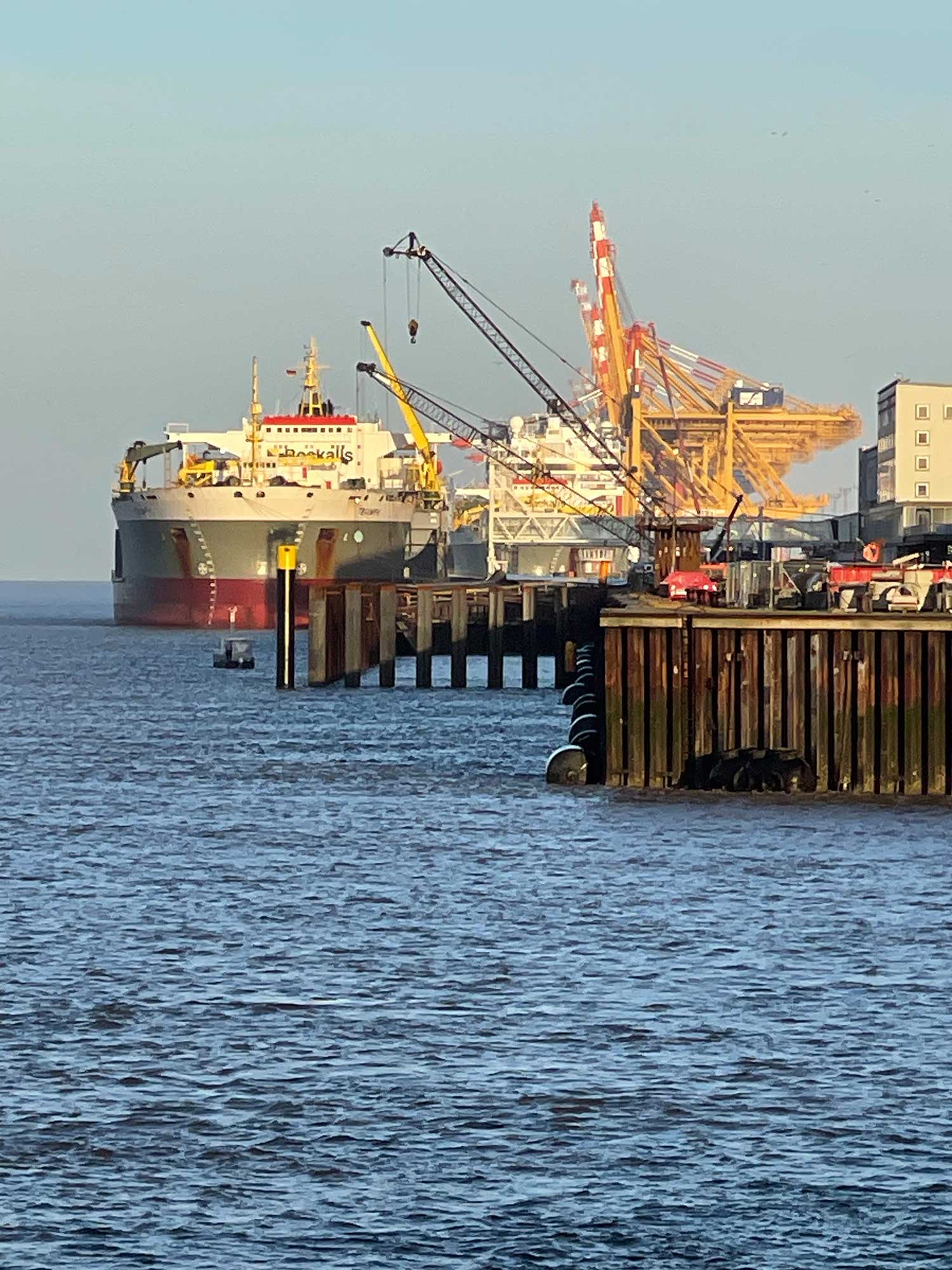
Bremerhaven Quay Wall
Project Data
Client
Industrial enterprise in Northern Germany
Captured Structure
Quay wall of a production facility
Project Period
2023
Project Scope
3D capturing of approx. 120 m of quay wall
Scope of Services
3D structural data acquisition above and below water
Analysis of Point-of-Interest areas and structural condition assessment
Identification of suitable cross-sections for residual wall thickness measurements
Execution and evaluation of residual wall thickness measurements according to HydroMapper specifications
Approximation of bending stresses
————————
Introduction
As part of a structural inspection of an industrial quay wall facility in Northern Germany, HydroMapper was commissioned to perform high-precision digital surveying of the port infrastructure both above and below water. The goal of the project was to establish a resilient data baseline for assessing the condition of the quay wall, as well as for structural recalculation and determining the remaining service life.
The quay wall was fully georeferenced using state-of-the-art HydroScanning, photogrammetry, and laser scanning technologies. In addition, the bending stress was approximated at two defined cross-sections to evaluate the actual stress on the sheet pile construction using real measurement data.
The analysis revealed that the actual loads on the quay wall were significantly below the originally assumed values. This established a solid foundation for structural reassessment and prevented excessive premature operational restrictions.
Initial Situation
For the upcoming structural inspection of the quay wall, the objective was to generate a comprehensive and highly precise data model of the current structural status. In particular, the goal was to calibrate the existing structural recalculations using real geodetic survey data and to provide a sound assessment of the remaining service life of the sheet pile wall.
The key challenge was to capture both the visible and underwater sections of the structure continuously, and to identify potential damage at an early stage. At the same time, complex geometric deformations of the sheet pile wall construction had to be documented precisely to perform the bending line approximation on a reliable datasets.
Therefore, both the underwater components of the quay wall and the areas above the waterline were scanned in a fully georeferenced survey and merged into a unified digital twin.
Our Approach
For the digital inventory capturing of the quay wall, a hybrid survey approach was used to precisely and completely capture the structure both above and below the waterline.
The underwater survey was conducted using modern hydrographic sensor systems such as MBES (Multibeam Echo Sounder), TriCam, and Profiler structures. Utilizing this sensor suite made it possible to capture even complex geometries, transition zones, and difficult-to-access structures in high resolution.
To achieve optimal overlap of the measurement data above and below water, the survey operations were scheduled around different tidal stages. In addition, processing, georeferencing, and alignment of all datasets were carried out to compile one consistent global digital model.
Furthermore, relevant Point-of-Interest areas were target-analyzed and suitable cross-sections were defined for residual wall thickness measurements. The resulting data formed the basis for advanced engineering analyses and the approximation of bending stresses on the quay wall.
From Physical Structure to Digital Twin
Through the combined application of advanced survey technologies, a high-precision digital twin of the entire quay wall was generated. The underwater areas were mapped in detail using hydrographic survey methods and seamlessly merged with the structural data captured above the waterline.
The derived data yielded high-resolution point clouds, elevation plans, and digital structural models that allow for a precise analysis of the geometry and current condition of the port infrastructure.
This digital fusion of all measurement data delivers a consistent, comprehensive view of the infrastructure and serves as the foundation for further structural analysis and maintenance planning.

The Foundation for Informed Decisions
Based on the high-resolution survey data, two bending line cross-sections were analyzed at different areas of the quay wall to evaluate the actual structural load and the remaining service life of the structure.
The results enabled a much more precise engineering assessment of the structural condition and delivered reliable data for the structural recalculation of the quay wall. This showed that the actual loads were lower than originally assumed.
The digital database thus supports well-informed decisions regarding further maintenance measures, operational safety, and long-term asset management strategies for the port facility.
Outlook and Future Use
The generated survey and analysis data present a sustainable foundation for future structural inspections, monitoring campaigns, and structural recalculations. With this digital documentation of the quay wall, future physical changes to the structure can be analyzed and evaluated efficiently over time. Concurrently, our InfraCloud environment provides all project stakeholders with centralized access to all measurement datasets, point clouds, orthophotos, and POI analyses.
Furthermore, the insights gained allow for more targeted planning of future maintenance measures and a sustainable assessment of the remaining service life of the port infrastructure. The high-resolution data thereby provides the foundation for long-term, data-driven infrastructure management.