References
Bremerhaven Quay

Project Data
Client
Private infrastructure operator in the port sector
Surveyed Structure
Sheet pile-supported harbor quay in Northern Germany
Project Period
2024
Project Scope
Survey of the harbor quay at Kaiserhafen Eins over a length of approx. 815 meters
Scope of Services
Underwater HydroScanning
HD mapping above the waterline
Georeferenced point cloud acquisition
Generation of high-resolution orthophotos
Evaluation of structural anomalies (POI)
Wall elevation plans above and below water
Data integration into the HydroCloud
Deflection curve approximation across ten cross-sections
Basis for calibrating static recalculations and residual service life analysis
————-
Introduction
As part of a technical reassessment of a harbor quay facility in Northern Germany, there was an imminent risk of having to decommission key infrastructure sections. A structural recalculation had indicated a calculated capacity utilization of around 150% – meaning that immediate shutdown of active harbor infrastructure was on the table. A closure would have had major logistics-level impacts on running port operations and local workflows.
To establish a solid technical baseline for further assessment of the quay wall, HydroMapper was commissioned with a high-precision 3D structural survey both above and below water. The goal was to capture the actual condition of the structure over the entire area, evaluate damage, and analyze the real stress distribution of the sheet pile design using deflection curve approximation.
Analyzing the survey data revealed that the actual stress on the quay wall was in fact just around 57%. This prevented a premature shutdown and allowed continuous port operations to run smoothly without any restrictions.
Initial Situation
The harbor quay facility under analysis in Northern Germany comprises extensive sheet pile and marine structures totaling roughly 815 meters in length. Before starting our survey work, there was no solid, area-wide data baseline covering the actual condition of the structure above and below water.
The calculated overload of the quay wall was largely based on theoretical assumptions without high-resolution as-built measurement data. At the same time, because of these calculations, there was a risk that a premature shutdown of the harbor facility might be initiated.
The objective of this project was therefore to generate a highly accurate digital as-built survey to objectively assess the current state (as-is) of the quay facility, pinpoint potential defects, and calibrate the structural recalculation using real-world structural data.
Our Approach
To deliver the digital as-built survey, HydroMapper combined several surveying and analysis techniques into a single, integrated workflow.
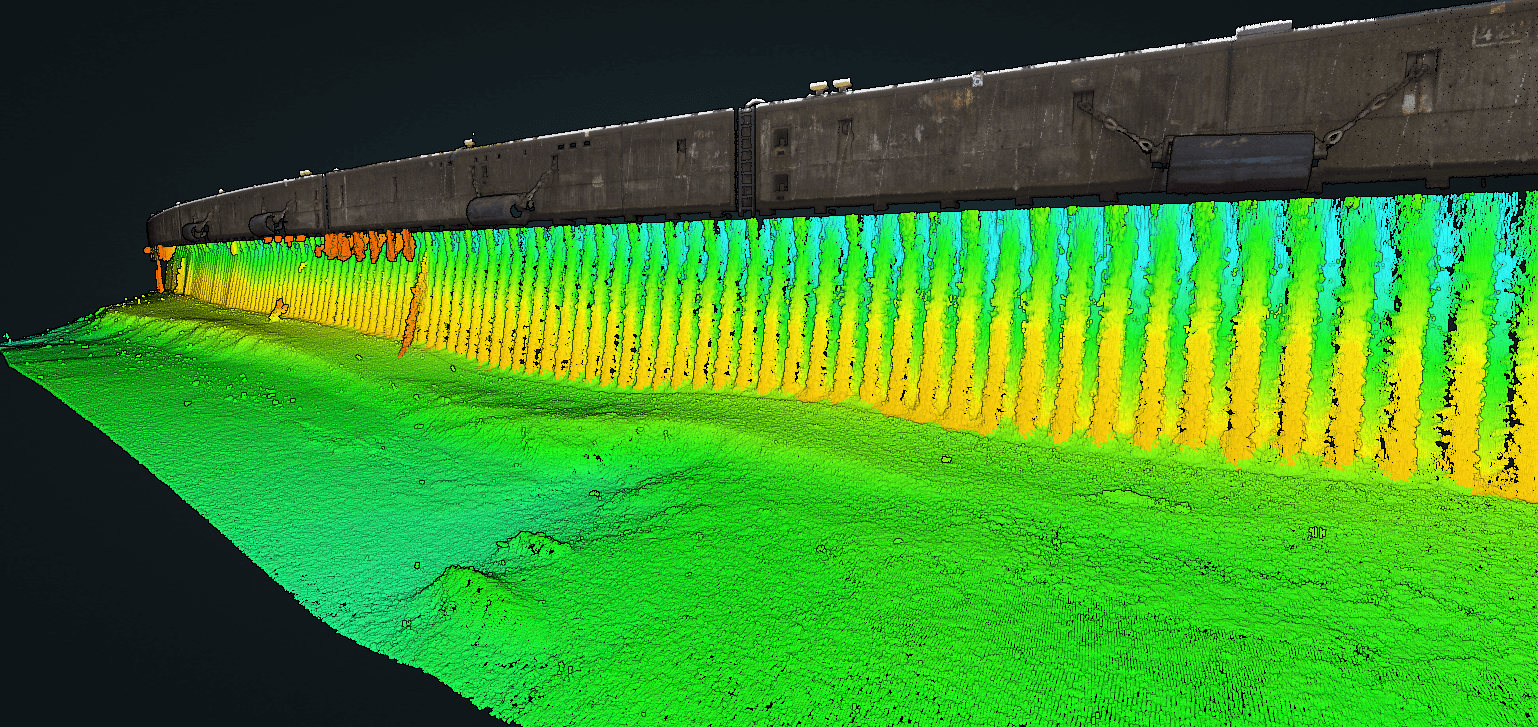
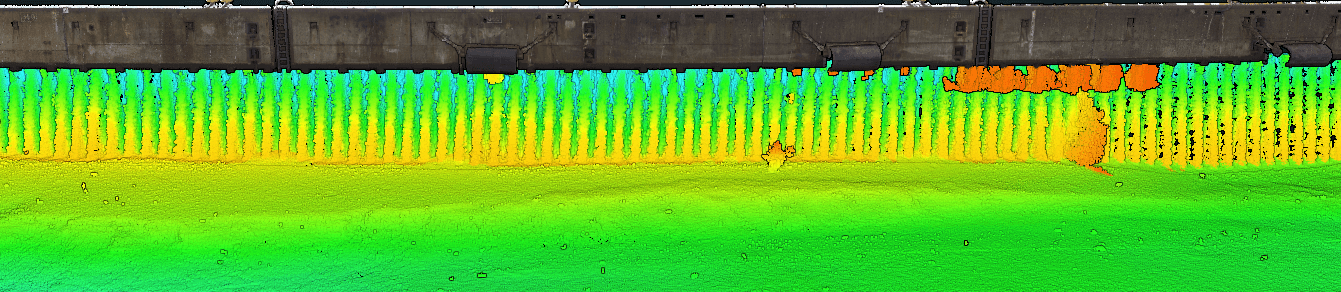
The underwater sections of the quay wall were captured using high-resolution, georeferenced HydroScanning. This allowed us to map even complex structural geometries, inclined surfaces, and pile groups in high digital detail. In addition, HD mapping of the sections above the waterline was carried out using laser scanning and photogrammetric methods.
The acquired data was merged in the InfraCloud and processed into a seamless digital asset model. Additionally, systematic assessment of structural anomalies was handled by defining Points of Interest (POIs) above and below water.
Subsequently, deflection curve approximations were carried out along ten defined cross-sections. Combined with residual wall thickness measurements, this workflow enabled us to analyze the actual stress on the sheet pile structure and calibrate the static recalculation based on real-world measurements.

From Asset to Digital Twin
By combining HydroScanning and HD mapping, we delivered a high-resolution digital twin of the entire port infrastructure above and below water.
The generated datasets included georeferenced point clouds, high-resolution orthophotos, wall elevation views, and digital structural models of the marine infrastructure above and below water. Anomalies and damaged areas were systematically flagged as Points of Interest and linked directly to the digital structural data.
Consolidating all measurement data in the InfraCloud provided a consistent, comprehensive view of the quay facility for the first time, establishing a robust foundation for technical analysis, condition assessments, and future maintenance planning.
The Basis for Solid Decisions
The high-resolution digital as-built survey served as the foundation for a precise engineering reassessment of the quay facility.
Using the deflection curve approximation, we were able to analyze the actual deformation curve of the sheet pile wall and determine the real stress on the structure. This showed that the actual utilization rate of the quay wall was in fact around 57% – significantly below the originally assumed 150%.
The results enabled a reliable technical assessment based on real-world measurement data and successfully averted a cost-intensive, premature closure of the harbor facility. At the same time, it established a robust data foundation for future structural inspections, structural assessments, and long-term maintenance strategies.
Outlook and Future Use
The generated survey and analysis data establish a reliable foundation for future structural inspections, monitoring campaigns, and the long-term preservation of the port infrastructure.
Thanks to the digital documentation of the quay facility, future changes to the structure can be detected early, assessed, and factored into future planning and maintenance measures. At the same time, the HydroMapper methodology provides a data-driven, objective decision-making basis for future structural recalculations and residual service life analyses.
Looking ahead, these insights can be leveraged to continuously monitor critical harbor structures, identify risks early on, and systematically plan future interventions. This forms a vital baseline for long-term, climate-resilient infrastructure management.